Research
What makes coffee good—and what deserves concern? August 2026
Good coffee is worth buying for flavor you enjoy, without paying extra for health promises. Start with traceable whole beans and repeatable brewing, then adjust caffeine and timing to sleep and symptoms. We explain those choices through sensory, process and health research.
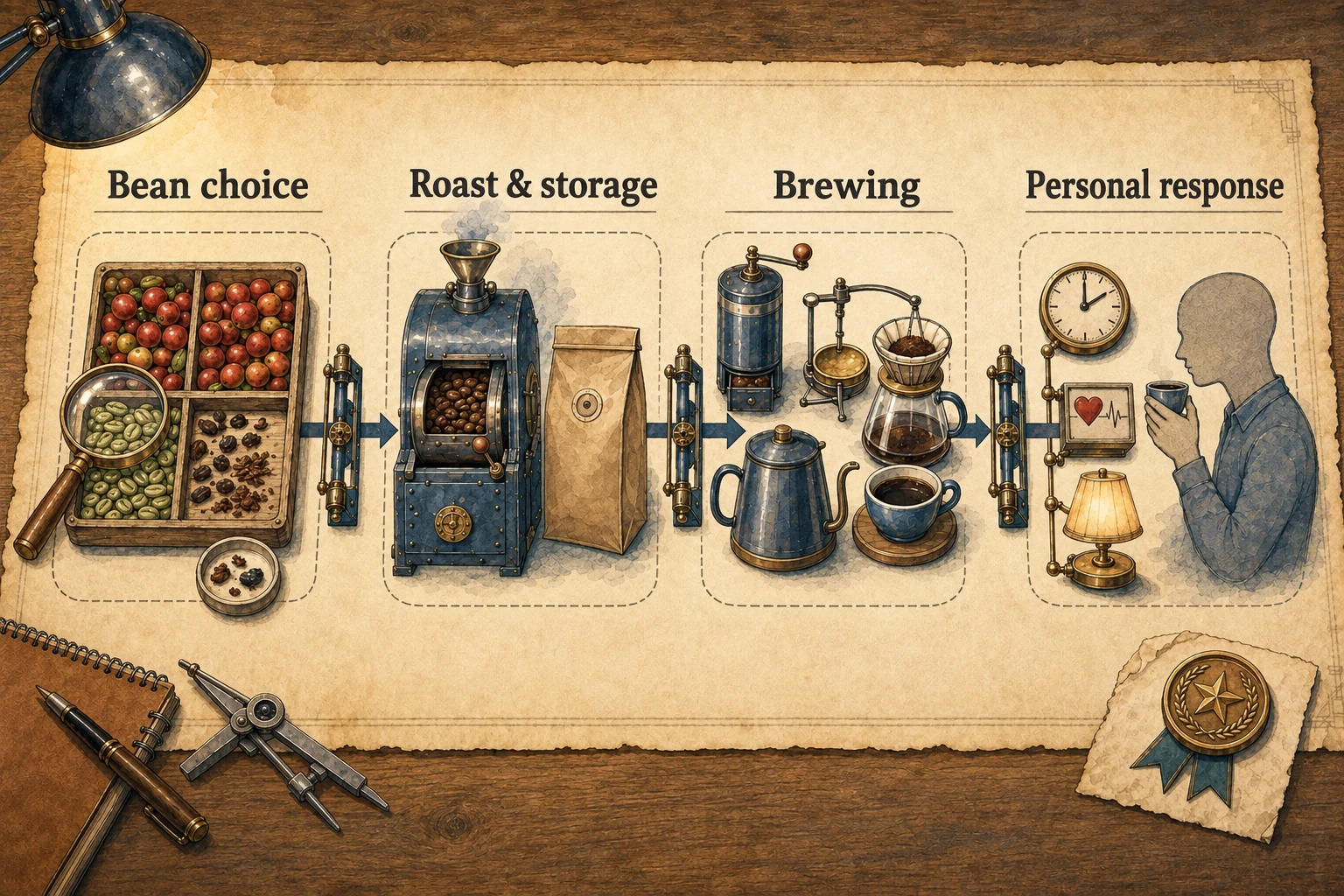
In this article
1 Where better coffee is worth the money
An expensive lot may offer less enjoyment than the blend you already drink. Origin, variety and fermentation can produce distinctive flavors without producing flavors you like. Grind the same beans differently, or keep them too long, and the cup changes again. The useful buying question is quite specific: does the extra money make this coffee more satisfying to drink?
I would first spend on manageable bags of traceable, roast-dated whole beans, grind them fresh and make the brew repeatable. Once the same recipe reliably tastes good, comparisons with pricier lots or equipment become useful. The health literature supplies no compelling reason for a non-drinker to start. For someone who already enjoys coffee, dose, sleep and recurring symptoms offer more practical reasons to adjust a daily habit.
This report follows those decisions from buying and brewing to health evidence. Its literature search closed on August 2, 2026; this rewrite retains that evidence and its study conditions. We have not tested the bag in your kitchen, and there is no best recipe for everyone. We can nevertheless explain which differences deserve attention and which numbers are easy to misread.
2 Scores, flavor and the beans in the bag
Professional assessment increasingly records these values separately. The Specialty Coffee Association's Coffee Value Assessment looks at physical attributes, objective sensory description, the assessor's or market's affective response, and extrinsic information such as origin, process, and certification. The separate fields keep "What did I perceive?", "Did I enjoy it?", "Was the raw material clean?", and "Is the story worth paying for?" in their proper contexts. A total score remains useful shorthand; the actual purchase should return to those observations.
Cupping is useful because it controls the comparison. Random codes hide brand and price. Samples use the same grind, ratio, water, and steeping procedure, then receive repeated observations as they cool. Very high temperature suppresses some sweetness and aroma and makes texture harder to judge. A cup that remains articulate as it cools, without phenolic, moldy, earthy, or rancid character, says more about lot and roast stability. Calibration gives several tasters common language for the sensory facts; enjoyment still belongs to the person drinking.
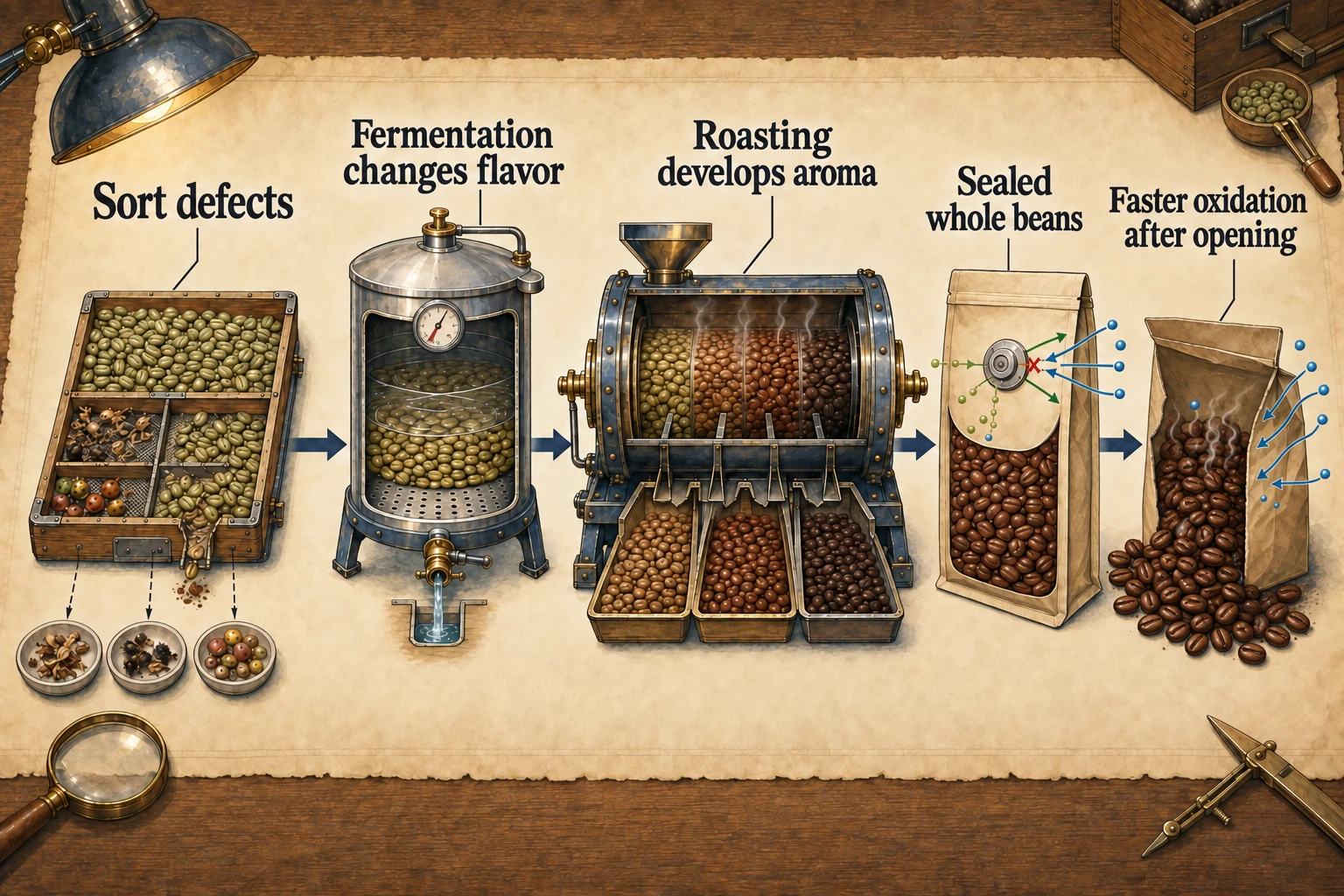
Quality differences appear as soon as the fruit leaves the tree. Immature, insect-damaged, black, or mold-damaged beans, foreign material, and uneven drying leave different off-flavors and food-safety problems. ISO 10470 groups green-coffee defects into five categories and gives them different weights according to their effects; SCA physical assessment also records color, moisture, and size. Those records show whether the raw material is clean and the lot is consistent. Preference for floral, nutty, or fermented-fruit character comes only after tasting.
Species, variety, growing conditions, screen size, and density give the roaster process information. Arabica and canephora differ in the distributions of caffeine, sugars, lipids, and aroma precursors, with large farm and variety differences inside each species. Screen size describes dimensions; density often relates to growing conditions and heat transfer. Both can help a roaster heat the batch evenly. Flavor ranking still returns to the defects, chemistry, and blinded result of this lot.
Washed, natural, honey, anaerobic, carbonic-maceration, and inoculated fermentations change the microbes, sugars, organic acids, and aroma precursors involved in processing. Research finds that variety, ripeness, culture, temperature, time, oxygen, and drying all change the final chemistry and flavor, so a process name can offer only a rough style expectation. A 2026 label experiment also found that calling the same coffee "fermented" or "carbonic maceration" changed consumer expectations and perception. Package wording itself therefore changes how people judge a cup.
Lot records separate an intended fermentation style from a process that went wrong. Fruit, wine, or lactic character may be the target; strong acetic, medicinal, putrid, moldy-earthy character or large within-lot variation points back to raw material, sanitation, temperature, or drying. "Anaerobic for 120 hours" is far from a complete method. Vessel, starting sugar, pH, temperature curve, culture, movement, and the decision to stop all matter. Retail buyers seldom need the complete production log, but a traceable roaster should be able to explain an anomaly and identify which coffee requires recall.
Roasting moves sugars, amino acids, and other precursors through Maillard chemistry, caramelization, and thermal decomposition. It generates volatile aroma compounds while changing chlorogenic acids, trigonelline, and bean structure. Chlorogenic acids generally fall as roast progresses and caffeine is comparatively heat-stable; caffeine per scoop or cup still changes with species, roast mass loss, volume measurement, dry dose, and extraction. Roast color describes only part of the flavor. Actual milligrams tell the drinker how much stimulant is present.
"Light," "medium," and "dark" have no single industry-wide ruler. A color instrument can make surface or ground-coffee reflectance easier to measure again, while development time, rate-of-rise history, probe placement, and heat transfer can still produce different internal structure and aroma at similar readings. SCA has published sensory standards and still lists green grading and roast-level standards as work in progress on its current standards page. Treat the roaster's term as a clue and let the cup decide what it means.
Roasted coffee releases carbon dioxide while taking up oxygen. Heavy early degassing can disturb extraction; later oxidation flattens aroma and gradually adds papery or rancid notes. The useful window changes with roast, package, and brew method. A practical routine checks the roast date, buys a manageable package, limits oxygen, moisture, heat, and light, and locates the window through repeated tasting. Grinding multiplies exposed surface area, so whole beans ground fresh often deliver a steadier improvement than an expensive new brewer.
The coffee valve in EP0659657A1 shows exactly what packaging can do: let gas out of the bag while limiting outside air. It helps only while the seal holds. Opening the bag, squeezing it repeatedly, closing it poorly, and pre-grinding all accelerate oxidation. A valve icon still leaves the roast date, package size, and time to finish the bag for the buyer to check.
Lot safety includes ochratoxin A, pesticide residues, foreign material, roast-formed acrylamide, and mold after poor storage. EU Regulation 2023/915 sets ochratoxin A maximums of 3.0 μg/kg for roasted beans and ground roasted coffee and 5.0 μg/kg for soluble coffee. Regulation 2017/2158 sets acrylamide process benchmarks of 400 μg/kg for roast coffee and 850 μg/kg for instant coffee. The first is a contaminant limit; the second checks whether mitigation practice is working.
A useful test report names the lot, sampling date and method, laboratory, analytical method, detection and quantification limits, analytes, result, and governing limit. A mold culture and an ochratoxin assay answer different questions, and a certificate with no lot number cannot vouch for the next bag. Homes cannot perform comprehensive chemistry. The practical choice is a supplier that preserves lot identity, runs a compliance program, traces complaints, and can recall affected product.
On the package, first look for the roast date, origin or blend, process, lot information and an intact, reusable seal. Flavor notes help with preference. Claims such as "mold-free," "toxin-free" and "laboratory tested" need lot-specific evidence. Price may also reflect microlot sorting, producer terms, identity preservation and ecological practices; contracts and audit records should explain what the premium pays for.
Organic, Fairtrade, rainforest, geographical-indication, and direct-trade claims constrain different things, including pesticides, trading terms, ecology, or origin. Their scope depends on the standard, certifier, audit frequency, and identity preservation through the supply chain. They can be a reason to purchase, but they still belong beside roast date, lot safety, and cup performance.
Scroll sideways to read the illustration.
3 Brew one cup, then improve the next
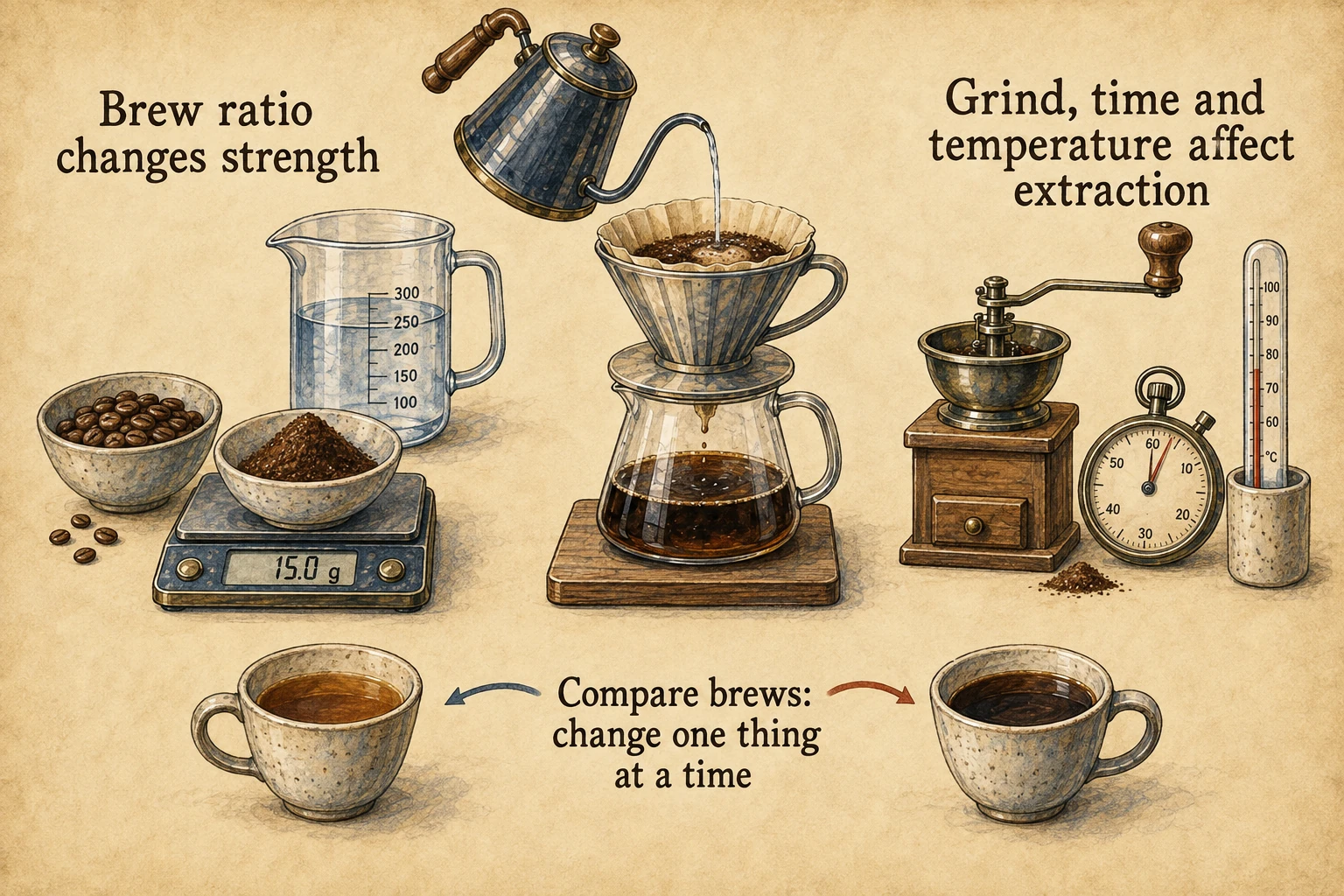
Start with a paper-filtered cup that is easy to compare: 15.0 g of coffee, 250 g of water, or 60 g/L; one fixed water temperature within 92–96°C; and a grind near the middle of the equipment maker's suggested range. Keep the scale, brewer, paper, pouring and vessel consistent. Note grind, total time, aroma, sweetness, acidity, bitterness, texture and finish as the cup cools. These are SOSEC starting values for home brewing; what you taste decides the next change.
Weak and poorly extracted are different problems. Strength is the concentration of soluble material in the drink, changing mainly with brew ratio and final beverage mass. Extraction yield is the fraction removed from the grounds, affected by grind, contact time, temperature, agitation, pressure, flow and water. Espresso can be strong and under-extracted; filter coffee can be dilute and evenly extracted. If a clean cup is too weak, add coffee or reduce water. If strength is comfortable but acidity is sharp, green and short, try a small move toward finer grind, longer contact or a higher effective temperature.
"Under-extracted" and "over-extracted" also leave many bad flavors unexplained. Raising average extraction in an even bed can continue to improve sweetness and clarity. Fines beside a channel may already taste dry while the untouched region stays hollow and sour, placing both effects in one cup. Char from a dark roast, cardboard from stale beans, and rancid oil from dirty equipment survive a grind adjustment. Check obvious bean and equipment problems first, then strength, extraction, and whether the bed is even.
For example, hold 15 g of coffee, 250 g of water, 94°C and grind setting 20 constant. Suppose strength feels comfortable but sharp acidity and a short finish remain as it cools. Change only the next grind to 18; if sweetness and finish improve, retain the change. The settings are illustrative and do not transfer between grinders. Add neighboring coarser and finer cups to test preference, taste in random order and leave price and packaging out of the comparison. One change at a time makes the cause easier to identify.
Lower strength for a lighter cup or raise it for more body, and record the change. A scale beats a scoop because roast levels have different bulk densities. Rigorous comparisons also record input water, dry coffee, and final beverage mass because the grounds retain water. Measurement has a plain purpose: it lets you make the same cup again.
Water temperature first changes the rate of extraction. SCA brewer certification has long used 92–96°C as an equipment performance range. A controlled 2020 sensory study compared brews at 87, 90, and 93°C while holding total dissolved solids and extraction yield constant and found no appreciable sensory effect. Boiling point also falls with altitude. At home, a fixed and repeatable temperature interpreted alongside roast and flow carries more value than a number treated as correct to the degree.
Water brings its own minerals and flavor into the cup. Calcium, magnesium, and bicarbonate affect extraction and acid buffering, while chlorine, off-odors, and excessive mineralization can be tasted directly. Experimental models find different binding tendencies between cations and flavor compounds; the full composition of the water and the coffee still determine the result. Pleasant tap water that produces the same flavor each time can remain in use. Persistent chalkiness, hollow acidity, or a large change in the same coffee between locations makes hardness and alkalinity worth measuring.
A grinder produces a particle-size distribution. Fines extract quickly and add resistance; large particles extract more slowly. A broad distribution can put dryness and hollow acidity into the same drink. Espresso pressure amplifies density differences and channels in the bed, while filter seating, pouring, and agitation create local shortcuts in pour-over. Make distribution, tamping, or pouring repeatable before moving the dial in small steps. Large moves after every cup usually conceal the source.
A refractometer measures total dissolved solids, which can then be used to estimate extraction yield. Filtration, temperature compensation, sample mixing, and input mass affect the reading. Consumer work behind the revised brewing control chart found at least two clusters of strength and extraction preference, so the chart helps people discuss flavor with the same numbers. A scale, fixed recipe, and blind cups solve most home problems. A café coordinating several people, lots, and machines gains more from refractometry because it can distinguish a drifting recipe from different preferences.
Coffee tastes different as it cools. Aroma, the balance of sweetness and bitterness, and texture become clearer at different temperatures. One sip immediately after brewing lets heat mask defects and can miss floral or fruit notes that appear later. Record impressions while the cup is hot, warm, and near room temperature, and note when another sip is most appealing. This improves tasting and naturally reduces the chance of swallowing coffee while it is still very hot.
Pour-over, immersion, moka pot, espresso, capsule, and cold brew all change coffee dose, water, grind, temperature, time, pressure, or flow; they differ mainly in automation and room for adjustment. The early capsule patent US4136202A uses a metered bed, sealed package, pressurized water, and controlled membrane opening to reduce differences between operators, while fixing dose and grind inside the system. Cold brew creates a different volatile, acidity, and texture profile; caffeine still depends on recipe and dilution. The method name gives only the broad idea. Serving size and the actual recipe determine what reaches the cup.
Clean equipment directly determines whether the same recipe keeps tasting good. Old coffee oils oxidize on grinders, screens, and pots; steam wands and milk circuits add microbial and allergen cross-contact concerns. Water rinsing cannot continuously remove accumulated oil, so follow the maker's schedule for disassembly, backflushing, and food-contact cleaners. If the flavor suddenly swings from cup to cup, or a rancid or sour-milk note appears, inspect cleaning and water before blaming the beans.
Scroll sideways to read the illustration.
4 Is the afternoon cup worth keeping?
A good afternoon coffee can still leave you awake at night. Changing the grind will not solve that problem; the useful variables are caffeine dose and timing. Converting "a cup" to milligrams matters because a large drip coffee, double espresso or less-diluted cold brew can change intake without changing the reported cup count.
Total caffeine follows species, dry coffee, contact, and serving size more closely. Espresso is concentrated per milliliter and small in volume; a large drip coffee may be less concentrated and carry more total caffeine through its water and dry dose. FDA's range for 12 fluid ounces of regular brewed non-specialty coffee is 113–247 mg, so one "cup" label already spans more than twofold. Color, bitterness, and brew time cannot supply a reliable home estimate. Prefer a current assay or shop figure for the product, then a published range for the same product, and finally FDA's broad category range. A new bean, larger dry dose, or less dilution of cold-brew concentrate requires a new estimate.
Sleep responds to both dose and timing. A 2023 systematic review and meta-analysis estimated that coffee containing about 107 mg of caffeine would need to be taken roughly 8.8 hours before bed to avoid a reduction in total sleep time; 8.8 hours is an average estimate. In a 2025 randomized crossover study of 23 moderately habitual male users, 100 mg at the tested 12-, 8- and 4-hour pre-bedtime points did not significantly change measured sleep, while 400 mg could disrupt sleep even 12 hours before bed. Participants did not always perceive the disturbance. The larger the dose, the earlier it should begin, followed by adjustment from the drinker's own sleep record.
FDA, EFSA and the 2026 AHA statement cited here use 400 mg/day as a generally safe upper boundary for most healthy adults, not a daily target. When first observing your response, keep a single dose at or below 200 mg and include caffeine from tea, chocolate, cola, energy products and medicines. SOSEC suggests initially placing the last serving 8–10 hours before bed, then moving it earlier or reducing the dose if sleep remains worse. Adjust that interval for dose and response.
Decaffeination lowers caffeine through water, ethyl acetate, methylene chloride, or supercritical carbon-dioxide separation. US4260639A shows moist coffee contacted by supercritical carbon dioxide at 40–80°C and 120–180 atmospheres, followed by activated-carbon capture and carbon-dioxide recirculation. US5208056A shows a water-based coffee extract and selective-adsorption route. Process names explain the separation mechanism. Starting coffee, selectivity, drying, and later roasting still form the flavor.
Concerns about methylene chloride in decaf should be judged from finished-product residue and the producer's compliance records. US 21 CFR 173.255 limits methylene-chloride residue in decaffeinated roasted and soluble coffee to 10 ppm. FDA's typical caffeine range for eight fluid ounces of decaf remains 2–15 mg. For a sensitive drinker, decaf's practical value is a large dose reduction while preserving the habit and much of the flavor. Residual caffeine still enters the daily total.
Cardiovascular response has acute and habitual components. Caffeine can raise blood pressure acutely, and CRAVE, a short randomized crossover trial in healthy adults, observed more premature ventricular contractions without a significant rise in premature atrial contractions; the next chapter explains its sample and observation period. A person with a diagnosed arrhythmia should take the diagnosis, medication, dose, and symptoms into a decision with a clinician. New palpitations call for a pause in escalation and a record of timing and rhythm. Chest pain, fainting, or a sustained abnormal rhythm needs prompt assessment.
Coffee's average effect on reflux is small, with large differences among people. A 2026 meta-analysis of 40 studies and 122,074 participants reported an odds ratio of 1.18 for GERD among coffee users, with I²=89%, and found no association with Barrett's esophagus; the authors judged clinical significance uncertain. Hold meal and drink timing steady and compare heartburn and nighttime symptoms with regular coffee, decaf, and no coffee. That record says more about the individual than the population average alone.
Pregnancy changes metabolism and risk tolerance. ACOG guidance reaffirmed in 2026 keeps daily caffeine below 200 mg and describes uncertainty for outcomes beyond miscarriage or preterm birth. Children and adolescents also do not inherit the adult 400 mg boundary; FDA cites pediatric advice to avoid energy drinks and highlights heart-rate, anxiety, sleep, and digestive effects. The same cup can therefore deserve a different answer depending on age, pregnancy, dose, time, and the person's actual response.
5 What the health research supports
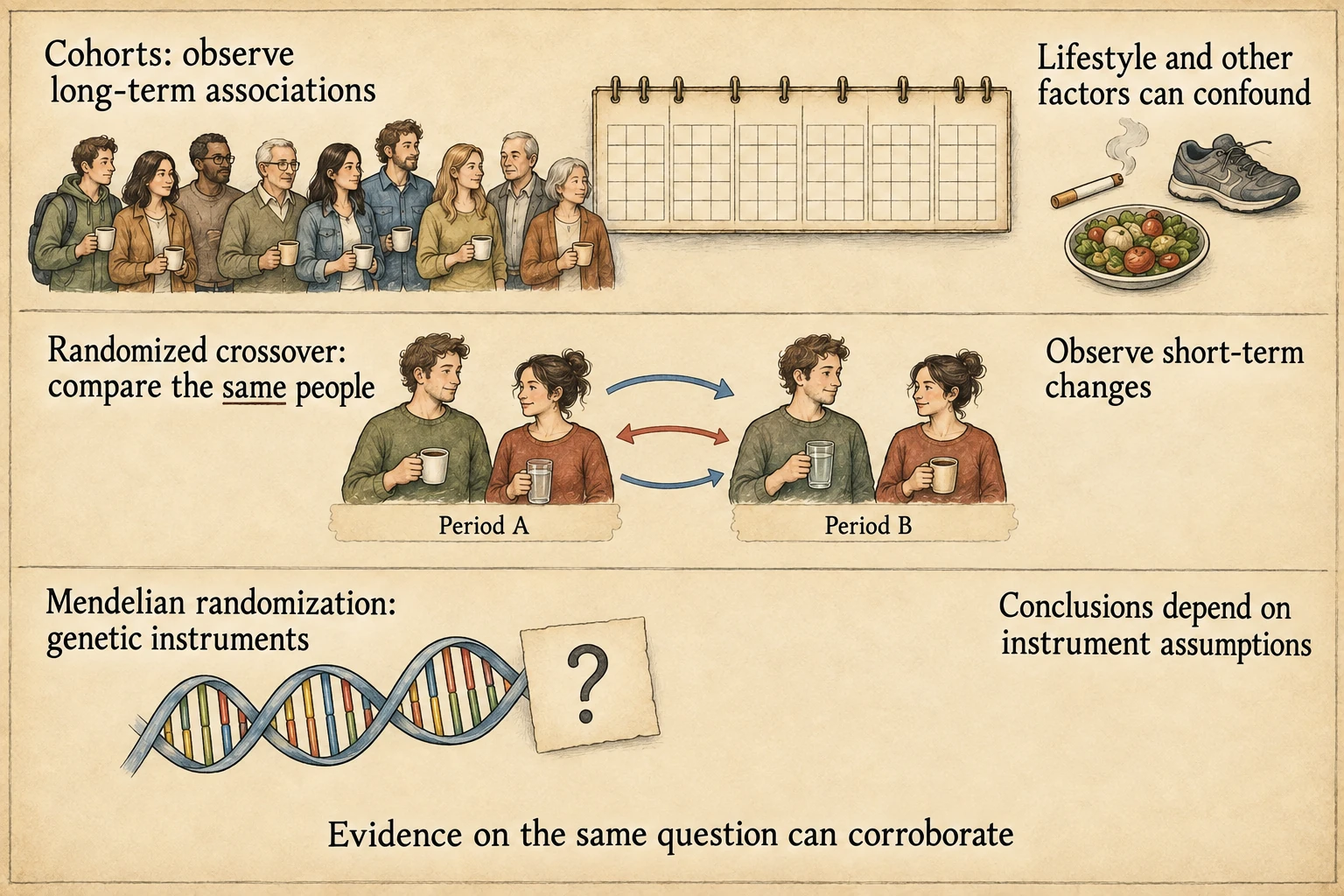
"Three or four cups a day are healthy" sounds like an answer ready to use. Coffee drinkers and non-drinkers may already differ in smoking, diet, work, sleep and illness. Long-term observation can show which groups develop less disease. Establishing whether coffee causes the difference requires other ways to check.
Long-term health research often produces a U- or J-shaped dose-response curve. A 2017 BMJ umbrella review assembled 201 observational meta-analyses covering 67 outcomes and 17 intervention meta-analyses covering nine outcomes; roughly three to four daily cups often sat near the low point of an observational curve. The review covers a great deal of research, while also inheriting different definitions of a cup and confounding from smoking, diet, income, occupation, sleep, existing illness, and people stopping coffee after becoming unwell. People who already like and tolerate coffee can keep moderate use within a healthy diet. People who abstain have no health reason to start.
A 2025 systematic review combined 59 Mendelian-randomization studies covering 160 disease or biomarker associations. The findings ran in beneficial and harmful directions, with no consistent protective effect. A genetic variant may affect several biological pathways at once, a problem called horizontal pleiotropy; the instruments may also reflect caffeine metabolism, drinking behavior, or other biology, and most samples were of European ancestry. Mendelian randomization can reduce some lifestyle confounding, but these limits leave the low-risk curves from observational studies as association evidence.
Short randomized trials answer narrower questions under better control. CRAVE assigned 100 healthy adults over 14 days to alternate between caffeinated coffee and avoidance, while wearables and ECG patches recorded responses. Coffee days brought about 1,058 more steps and roughly 36 fewer minutes of sleep. Premature atrial contractions did not significantly rise; premature ventricular contractions rose from about 102 to 154 per day, and glucose showed no significant difference. Some devices failed, leaving 81–87 people in the analysis of each outcome. Two weeks and missing data cannot answer questions about long-term disease.
"Three to four cups" first has to be translated back into the study's cup size, method, and population. Some questionnaires ask only whether a participant drinks coffee; others define a cup as 120 or 350 mL and may group drip, espresso, instant, and decaf together. A baseline questionnaire can also stand in for years of changing behavior. Relative risk needs the baseline absolute risk, confidence interval, heterogeneity, and follow-up beside it. To apply a study personally, turn that 600 mL drink, double espresso, or sweetened preparation into actual milligrams, volume, and symptoms, then ask whether the study participants really resemble the drinker.
A change in preparation is easier to examine experimentally than a long-term disease association. Paper filtration offers a useful example.
Filter material first changes oil-phase diterpenes. Cafestol and kahweol occur in coffee oil. A randomized trial of 107 young adults with normal lipids compared four to six daily cups of boiled and paper-filtered coffee for nine weeks; total cholesterol was 0.48 mmol/L higher with the boiled preparation. The LDL point estimate was 0.39 mmol/L higher, with a 95% confidence interval that crossed zero. Later work locates the method difference in diterpenes and the amount of oil-phase material that passes the filter.
Metal filters, French press, Turkish coffee, and some espresso retain more oil-phase material, with machines, beans, dose, and serving size creating a wide concentration range. An occasional cup for someone with normal lipids is plainly different from high-volume daily use by someone with elevated LDL. For the latter, switching to paper is cheap and easy to reverse. Paper mainly retains oil-phase diterpenes, while most water-soluble caffeine passes through, so changing the filter does not replace managing caffeine dose.
Serving temperature needs its own decision. In 2016, IARC classified beverages consumed above 65°C in Group 2A because of repeated thermal injury; coffee itself entered Group 3. The practical answer is to let the drink cool, especially before repeated large swallows from a device that keeps it hot. Tasting from hot to warm already provides that cooling time and improves flavor assessment.
Sugar, flavored syrup, cream, nondairy creamer, and alcohol also belong to the complete recipe. Black coffee is very low in energy; additions can turn it into a high-free-sugar, high-saturated-fat, or dessert-sized serving. WHO recommends keeping free sugars below 10% of total energy, with potential additional benefit below 5%. Recording sugar and milk in real quantities describes what the body receives more faithfully than discussion of one "antioxidant" in coffee.
Scroll sideways to read the illustration.
6 A habit you can enjoy
Learning how coffee affects you takes several days of notes because memory easily mismatches dose and outcome. Hold dry dose, brewing method, breakfast, and drinking time steady and record one week of caffeine in milligrams, sleep onset, awakenings, next-day function, palpitations, anxiety, reflux, and headache. In the next round, change only regular coffee to half-caf or decaf, or move only the time earlier. This comparison suits mild, stable problems; an effect becomes persuasive only when it repeatedly changes with dose. Chest pain, fainting, a sustained rhythm disturbance, a pregnancy complication, or active treatment for blood-pressure, rhythm, psychiatric, gastrointestinal, or liver disease puts clinical judgment first.
Tolerance and withdrawal can distort a single day's impression. Regular exposure may make the same dose feel less stimulating; abrupt cessation commonly brings headache, fatigue, irritability, and impaired concentration, so part of a morning cup's "lift" may be relief of overnight withdrawal. Reduce over several days with half-caf or decaf while sleep and meals remain stable to see whether the coffee that remains genuinely improves work or mood. CYP1A2, ADORA2A, pregnancy, smoking, oral contraceptives, liver function, and some medicines can all change clearance or response. Actual dose, time, and symptoms remain the most direct personal evidence.
Coffee can remain part of an ordinary diet; it cannot replace treatment for blood pressure, lipids, diabetes or another condition. Long-term benefits are supported mainly by observational associations. Disease, medication and actual response still determine whether continued use suits an individual.
If the coffee you enjoy still tastes good earlier in the day or as decaf, with less lost sleep or discomfort, that is a change worth keeping. If expensive beans and equipment bring no flavor you prefer, there is equally good reason to stop spending. Research is most useful when it helps identify the next useful adjustment. Enjoying a familiar cup does not require turning it into a daily test of expertise.
Literature search and public bibliography
To find as much of the coffee literature as possible, we exhaustively retrieved 52,400 Crossref hits for query.bibliographic=coffee, 5,909 for query.bibliographic=coffea, and 24,571 PubMed records matching coffee or Coffea in the title or abstract or carrying the Coffee MeSH heading by August 2, 2026. Conservative deduplication by DOI, PMID, and exact title plus year where identifiers did not conflict turned 82,880 source hits into a public ledger of 71,087 candidates. It retains title, date, type, venue, identifiers, source, automated tags, and metadata warnings; database, query, date, and counts follow the reporting concerns in PRISMA-S.
Those 71,087 entries are candidate records: papers and reviews sit beside preprints, chapters, datasets, complete journal issues, and search noise. Automated checks flag 479 likely homonyms such as T-Coffee and coffee-ring research and 19 records missing a source title. OpenAlex counts of 82,521 title hits and 58,649 topic hits serve only as rough independent scale checks. The public ledger lets readers see what we searched and where gaps may remain. The report itself uses the systematic review, randomized trial, mechanism study, standard, regulation, or process patent that fits each question; candidate volume never gets a vote.
Research basis
Research basisAs of 2026-08-02 04:38 CST, this report completely enumerates the Crossref bibliographic queries for coffee and Coffea and the PubMed title, abstract, and MeSH query: 82,880 source hits merged into 71,087 public candidate records by DOI, PMID, and exact title plus year only when persistent identifiers do not conflict. It then reviews decision evidence from green-bean defects, fermentation, roasting, storage, grinding, water, extraction, and filtration through caffeine, diterpenes, serving temperature, additions, and individual response. Industry standards, regulatory limits, process patents, chemical and sensory experiments, short randomized trials, prospective observational research, and Mendelian randomization are interpreted as separate evidence classes. The census boundary is the named public indexes, exact queries, and cutoff. SOSEC did not assay a retail lot or provide individual medical care. The 60 g/L ratio, 92–96°C water, and an 8–10-hour pre-bed caffeine cutoff are starting recommendations for home brewing; preference, measured caffeine, sleep, and symptoms must calibrate them.
SourceCrossref and PubMed literature-candidate census / SCA and ISO coffee assessment standards / FDA, EFSA, IARC, ACOG, EU regulations, and the US Code of Federal Regulations / the BMJ umbrella review, randomized crossover trials, Mendelian-randomization review, and sleep and brewing studies / decaffeination, capsule, and one-way-valve patents / SOSEC evidence-layer review on 2026-08-02
Evidence confidence Medium-high
7Evidence and sources
7.1What we examined
SOSEC starting recommendation; calibrate for strength, extraction, and preference
The FDA, EFSA, and 2026 AHA generally safe ceiling for most healthy adults; it supplies no intake target
Current ACOG guidance; total from foods, drinks, and medicines
IARC definition for the probably carcinogenic very-hot exposure; allow the drink to cool
Conservative SOSEC starting recommendation, calibrated against dose and actual sleep
7.2Timeline
- Supercritical-carbon-dioxide decaf patent takes priority
Kurt Zosel's patent family combines moist beans, pressure, temperature, activated-carbon capture, and carbon-dioxide recirculation into a selective decaffeination route.
- Pressure-opened coffee capsule patent takes priority
Eric Favre's capsule combines a metered bed, sealing, pressure, and membrane opening into a repeatable brewing system.
- IARC separates coffee from very hot beverages
Coffee enters Group 3; beverages consumed above 65°C are classified as probably carcinogenic because of the esophageal-cancer evidence.
- SCA formally adopts three Coffee Value Assessment standards
SCA-102, SCA-103, and SCA-104 supersede the 2004 protocol and form; by this report's cutoff, SCA-105 Extrinsic Assessment also appears among published standards.
- Systematic review of Mendelian-randomization studies goes online
Fifty-nine studies and 160 associations show a more complicated long-term causal picture than the observational protection narrative.
- AHA publishes caffeine and cardiovascular statement
The statement retains a 400 mg/day boundary for most adults while emphasizing dose, source, additions, and individual response.
7.3Sources and material
- SCA Coffee Value Assessment and its four-part frameworkhttps://sca.coffee/value-assessment
- SCA announcement formally adopting three CVA cupping standards in 2024https://sca.coffee/sca-news/sca-new-cva-cupping-standards-7ga28
- Current SCA coffee assessment and brewing standardshttps://sca.coffee/research/coffee-standards
- Historical SCA temperature, ratio, and time requirements for certified home brewershttps://sca.coffee/s/2017-SCA-CHB-Program-Requirements-ba6g.pdf
- SCA discussion of a 60 g/L start, water, acidity, and brewing methodhttps://sca.coffee/sca-news/25/issue-9/english/water-and-coffee-acidity-how-to-adapt-your-water-for-different-extraction-methods-25-magazine-issue-9-pxjby
- ISO 10470 green-coffee defect reference systemhttps://www.iso.org/standard/40401.html
- FDA caffeine dose, beverage range, decaf residue, and adverse effectshttps://www.fda.gov/consumers/consumer-updates/spilling-beans-how-much-caffeine-too-much
- EFSA caffeine single-dose, daily, and pregnancy safety assessmenthttps://www.efsa.europa.eu/en/topics/topic/caffeine
- AHA summary of the 2026 caffeine and cardiovascular scientific statementhttps://newsroom.heart.org/news/coffee-and-heart-health-how-many-cups-of-caffeinated-coffee-are-safe-to-drink-each-day
- Circulation: Caffeine and Cardiovascular Disease scientific statementhttps://www.ahajournals.org/doi/10.1161/CIR.0000000000001454
- BMJ umbrella review of coffee and health outcomeshttps://www.bmj.com/content/359/bmj.j5024.long
- Nutrition Research Reviews: systematic review of Mendelian-randomization evidencehttps://www.cambridge.org/core/journals/nutrition-research-reviews/article/coffee-and-health-outcomes-a-systematic-review-of-mendelian-randomisation-studies/0197AC8D6B78857745BBDEA1654BA747
- NEJM / PMC: full text of the CRAVE randomized case-crossover trialhttps://pmc.ncbi.nlm.nih.gov/articles/PMC10167887/
- Sleep Medicine Reviews: meta-analysis of caffeine dose, timing, and sleephttps://pubmed.ncbi.nlm.nih.gov/36870101/
- Sleep: randomized crossover study of 100 mg and 400 mg timinghttps://pmc.ncbi.nlm.nih.gov/articles/PMC11985402/
- NEJM: randomized boiled- versus filtered-coffee lipid trialhttps://www.nejm.org/doi/full/10.1056/NEJM198911233212103
- Food Research International: paper-filter retention of coffee diterpeneshttps://www.sciencedirect.com/science/article/pii/S0963996918302175
- Nutrition, Metabolism and Cardiovascular Diseases: diterpene variation in workplace machineshttps://www.sciencedirect.com/science/article/pii/S0939475325000870
- Scientific Reports: brew-temperature sensory study at fixed strength and extractionhttps://www.nature.com/articles/s41598-020-73341-4
- Journal of Food Science: revised brewing control chart and consumer preferenceshttps://ift.onlinelibrary.wiley.com/doi/10.1111/1750-3841.16531
- Journal of Agricultural and Food Chemistry: model of water cations and coffee compoundshttps://pubmed.ncbi.nlm.nih.gov/24802110/
- Scientific Reports: fines and espresso-extraction dynamicshttps://pubmed.ncbi.nlm.nih.gov/38453983/
- Physics of Fluids: uneven flow and coffee-extraction modelhttps://doi.org/10.1063/5.0138998
- Scientific Reports: cold- and hot-brew volatile and sensory comparisonhttps://www.nature.com/articles/s41598-024-69867-6
- Foods: review of cold-brew chemistry, sensory properties, and microbiologyhttps://pmc.ncbi.nlm.nih.gov/articles/PMC9407127/
- Journal of Agricultural and Food Chemistry: chlorogenic-acid changes during roastinghttps://pubmed.ncbi.nlm.nih.gov/19530715/
- Food Chemistry: systematic analysis of factors that affect coffee acidityhttps://pubmed.ncbi.nlm.nih.gov/34553656/
- Foods: caffeine, chlorogenic acids, and trigonelline in arabica and robusta roastinghttps://pmc.ncbi.nlm.nih.gov/articles/PMC10558851/
- SCA literature review of roasted-coffee stalinghttps://sca.coffee/sca-news/2012/02/15/what-is-the-shelf-life-of-roasted-coffee-a-literature-review-on-coffee-staling-bjcx7
- Journal of Agriculture and Food Research: post-opening package and storage comparisonhttps://www.sciencedirect.com/science/article/pii/S2214289422000850
- Food Research International: review of emerging coffee-fermentation methodshttps://pubmed.ncbi.nlm.nih.gov/36716620/
- Food Quality and Preference: effect of process labels on consumer perceptionhttps://pubmed.ncbi.nlm.nih.gov/42073175/
- Acta Gastro-Enterologica Belgica: systematic review and meta-analysis of coffee and GERDhttps://pubmed.ncbi.nlm.nih.gov/41677121/
- ACOG pregnancy caffeine opinion, reaffirmed in 2026https://www.acog.org/clinical/clinical-guidance/committee-opinion/articles/2010/08/moderate-caffeine-consumption-during-pregnancy
- CNS & Neurological Disorders: CYP1A2, ADORA2A, and caffeine-response reviewhttps://pubmed.ncbi.nlm.nih.gov/37029915/
- IARC Monographs Volume 116: coffee, maté, and very hot beverageshttps://www.iarc.who.int/news-events/iarc-monographs-volume-116-drinking-coffee-mate-and-very-hot-beverages/
- EU Regulation 2023/915 on maximum levels for contaminants in foodhttps://eur-lex.europa.eu/legal-content/EN/TXT/?uri=CELEX%3A32023R0915
- EU Regulation 2017/2158 on acrylamide mitigation and benchmarkshttps://eur-lex.europa.eu/legal-content/EN/ALL/?uri=CELEX%3A32017R2158
- WHO healthy-diet and free-sugar guidancehttps://www.who.int/en/news-room/fact-sheets/detail/healthy-diet
- 21 CFR 173.255 methylene-chloride requirement for decaf coffeehttps://www.ecfr.gov/current/title-21/chapter-I/subchapter-B/part-173/subpart-C/section-173.255
- US4260639A: supercritical-carbon-dioxide decaffeinationhttps://patents.google.com/patent/US4260639A/en
- US5208056A: water-extract and selective-adsorption decaffeinationhttps://patents.google.com/patent/US5208056A/en
- US4136202A: pressure-opened coffee capsulehttps://patents.google.com/patent/US4136202A/en
- EP0659657A1: coffee-package degassing valvehttps://patents.google.com/patent/EP0659657A1/en
- Crossref REST API: bibliographic metadata queries and cursor paginationhttps://www.crossref.org/documentation/retrieve-metadata/rest-api/
- NCBI E-utilities: PubMed search, history, and batch retrievalhttps://www.ncbi.nlm.nih.gov/books/NBK25499/
- PRISMA-S: reproducible reporting items for literature searcheshttps://www.prisma-statement.org/prisma-search