Vulnerability research
Citrix NetScaler: when a log entry becomes a command
NetScaler CVE-2026-88771 is being exploited, and public patch analysis shows logged input entering a shell command; operators should preserve evidence and install the appropriate fixed build, with 14.1-73.37 or 13.1-64.24 as the current targets for the standard branches.

In this article
A failed login usually leaves a username, an error and a timestamp. The system keeps them so an administrator can investigate later. In this NetScaler vulnerability, that later use is where the trouble develops. Text from an external request reaches a log; a maintenance script reads the log, builds a filename from it and inserts that filename into a shell command. Content that should only describe a request gains a way to direct operations on the appliance.
On September 27, Citrix confirmed exploitation of CVE-2026-88771 and CVE-2026-88772 in bulletin CTX697096 and released fixes. CISA added both to its KEV catalog that day. Australia's ACSC advisory on September 28 also described global exploitation before a patch was available. watchTowr published script differences for 88771 on the 28th, making the route from a request to a background task much clearer.
Operators now have two urgent jobs: prevent further access through the vulnerable code and establish what happened before the update. Updating changes the system under investigation; leaving it exposed carries its own risk. We recommend restricting reachability while arranging evidence preservation and patching together. The current standard-branch targets are 14.1-73.37 and 13.1-64.24. The latter is one build beyond the first security fix because an upgrade problem can cause cyclic reboots under a particular configuration. That distinction matters when choosing the package.
1 The request ends, but its text keeps moving
The two exploited vulnerabilities have different requirements. CVE-2026-88771 permits unauthenticated command execution across affected NetScaler ADC and Gateway deployments, including the default configuration. CVE-2026-88772 is a separate memory-overflow issue requiring DTLS, which VPN virtual servers enable by default. Turning DTLS off changes the prerequisite for 88772; the log-processing path in 88771 still needs its fix. CISA describes the two issues as independently capable of remote code execution, so a configuration check for one cannot clear the entire bulletin.
The bulletin covers customer-managed appliances, including NetScaler instances used by Secure Private Access Hybrid. Citrix updates its managed cloud services and managed Adaptive Authentication. For customer-managed systems, an inventory limited to visible VPN login pages would be too narrow: the vendor lists no optional feature requirement for 88771. Start with the firmware and deployment inventory, including standby instances.
A failed login can still supply text because authentication services record parts of failed requests for troubleshooting. Validating an account and logging the supplied account string are separate operations. In watchTowr's published observations, a login field appears in authentication-related logs. When another program later reads that line from disk, it needs to establish which parts of the line it can trust for its own task.
The public comparison identifies /netscaler/ns_monuploadd_err.pl on the appliance. The researcher compared 14.1-73.30 with 14.1-73.37, showing changes to core-filename extraction and the invocation of find. Our explanation follows those data transformations. The complete vendor script, commit history and original line numbers are not public; SOSEC did not obtain firmware or independently reproduce the appliance exploit. The published patch excerpt supports the analysis below, and the reported appliance execution belongs to the researcher's experiment.
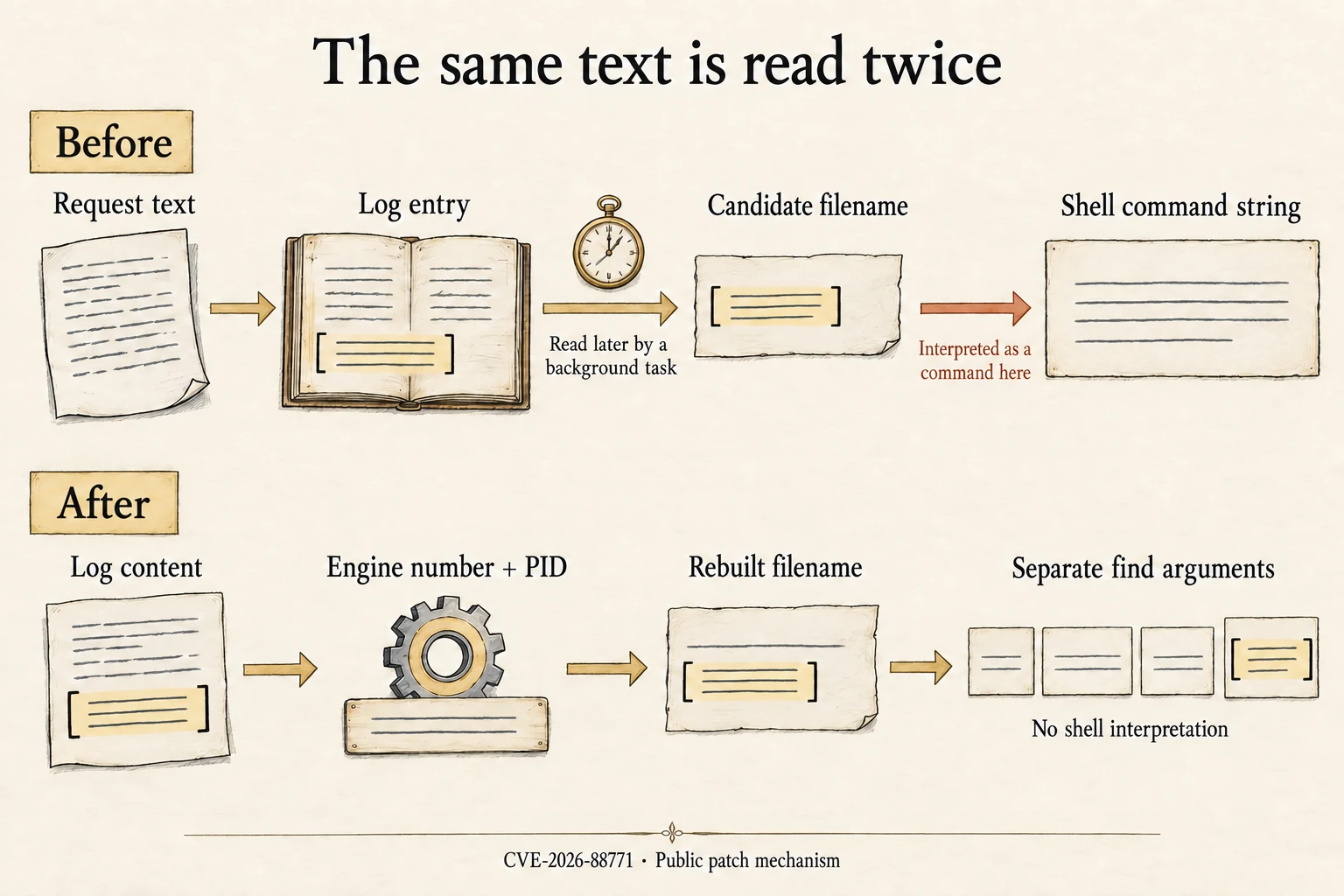
The script has a legitimate diagnostic job: find a log message about a Packet Engine failure, then locate the corresponding core file. A core contains process memory for later investigation. An engine name and process identifier from a normal message can be combined into a candidate filename:
pitboss: NSPPE-00 (12345) unexpectedly died
                         ↓
                 NSPPE-00-12345
Here, NSPPE-00 names the engine and 12345 is an example process ID. Those are the constrained fields the diagnostic task needs. The old implementation instead selected text from a keyword-matching log line: it found what looked like a process failure, kept the last matching line, then used sed and awk to remove characters and join fields. The keywords could occur anywhere in a line. Matching them did not establish that the selected text was a structured field written by the process-failure reporter.
2 The second interpretation gives the text its power
The extracted value is still a Perl string at this point. Shell separators in the output of the first pipeline do not execute merely because the pipeline prints them. The consequential change comes with the next use: the old script interpolates the candidate name into another backtick command and asks a shell to run find. Data and command syntax now share one string.
This pseudocode preserves that transition while leaving out log paths and unrelated diagnostic work:
candidate = fields_selected_from_log
command_text = "find " + core_directory + " -name " + candidate + "* ..."
core_path = run_through_shell(command_text)
The script intends candidate to occupy only the filename-pattern position. The shell receives the complete command text and interprets its syntax. It has no separate record of which characters the programmer supplied and which came from a previously logged request. This is the command injection: external text travels through a log and a filename variable until a later consumer interprets it as part of a language.
The same path explains the timing. A request can populate a log before the maintenance task reads it. The researcher reported waiting for that background work and showed command execution with root privileges in the tested appliance. An investigation therefore needs to relate request timestamps to later process and file activity. An HTTP response establishes only that a request was handled; it cannot establish when the background code ran. A waiting interval reported in a test is no guaranteed grace period for defenders.
That is why we would not rely on blocking one login URL or one public example string as temporary protection. The relevant inputs are those that can reach the searched logs, and the old script subsequently consumes those logs. The researcher demonstrated a particular entry point; the vendor's affected-configuration scope is broader. Public evidence does not establish a complete interception rule for every deployment. Where patching cannot be completed promptly, isolating or taking the affected service offline removes reachability at the cost of remote access or application delivery. Source restrictions reduce exposure while leaving requests from allowed sources able to reach the appliance.
3 The patch keeps the filename as data
The fix preserves the diagnostic job. It first narrows extraction: Perl reads the log files directly, captures the engine name and the numeric process ID inside parentheses, then reconstructs the filename. The two captures in the published expression are (NSPPE-\d{2}) and (\d+). Surrounding log text does not travel into the reconstructed name. A legitimate diagnostic lookup still gets its identifiers without adopting two arbitrarily clipped fields.
The invocation of find changes as well. The patch uses the list form of Perl's pipe open, passing the executable and its arguments separately. The Perl documentation distinguishes this from a command string: the list supplies literal arguments to the child process, without asking a shell to split them again. Shell syntax characters in an argument remain part of that argument's value.
When using open, distinguish a command string from a list of separate arguments. The string form can ask a shell to interpret a complete command; the list form used in this patch keeps the arguments apart. The following is an independent API example, not an excerpt from the appliance script:
open(my $results, '-|', 'find', $core_directory,
     '-type', 'f', '-name', $validated_name)
    or die "cannot start file search";
The published changes also narrow the search from a filename prefix to the exact candidate or its .gz form, then check the entire returned path against \A[A-Za-z0-9\/\-.]+\z. The anchors require the whole value to match. According to the researcher, older backtick invocations later in the script still consume that path, giving this final check a practical purpose. These are the changes available for inspection; other branches in the complete script were outside this review.
A useful code-review question follows from this repair: when text acquires a new use, is the program passing a value or constructing a language expression again? Logs, queues and databases can all retain control originally held by a requester. Moving the text into an internal file does not change who supplied it. Reading the field restriction alongside the separated arguments explains why the patch changes both operations.
4 The update also changes operational behavior
The repair has to reach the running firmware. This table separates the bulletin's first security-fixed builds from the targets available on the vendor download page on September 29. Each row applies to its own branch; FIPS and standard packages are not interchangeable. An unsupported older branch gains no assurance from being absent here and needs a migration to a supported fixed branch.
| Branch | First security fix | Current target |
|---|---|---|
| ADC / Gateway 14.1 | 14.1-73.37 | 14.1-73.37 |
| ADC / Gateway 13.1 | 13.1-64.23 | 13.1-64.24 |
| ADC 14.1 FIPS | 14.1-73.37 FIPS | 14.1-73.37 FIPS |
| ADC 13.1 FIPS / NDcPP | 13.1-37.279 | 13.1-37.279 |
The vendor's additional guidance explains the 13.1 difference. An upgrade to 64.23 can cause cyclic reboots on appliances with configured variables; 64.24 avoids that known operational problem. The read-only command show ns variable identifies whether variables are configured. Empty output excludes that particular reboot prerequisite, not the security vulnerabilities. With 64.24 now available, it is the straightforward choice for a newly scheduled standard 13.1 upgrade.
An operator already on 64.23 may face a different puzzle: Console still reports the CVE. Citrix says Security Advisory detection logic could temporarily misclassify this fixed build and would be corrected by a logic update. That is separate from the variable-related reboot. Check the actual firmware, configured variables and detection-logic date, then deal with each issue on its own evidence. A red scan result alone is no reason to restore vulnerable firmware.
SAML deployments also need an identity-provider check. The vendor says assertions must now be signed and validated, and an existing samlRejectUnsignedAssertion OFF configuration is converted to the secure default during upgrade. A connection that relies on unsigned assertions may stop authenticating. Verify that the IdP signs assertions and test the legitimate business login before restoring service. This change can explain an authentication failure after an update; it does not justify reopening an unpatched gateway.
CVE-2026-88778 in the same bulletin requires an additional configuration action: applicable TCP deployments need Enhanced ISN Generation enabled. The official command documentation describes its effect on TCP connections where NetScaler acts as the server. Installing firmware does not substitute for checking and changing that setting. Review the other CVEs against their HTTP, Gateway/AAA, Oracle load-balancing and non-HTTP L7 prerequisites without enabling services that the deployment does not use.
If the upgrade fails, retain isolation while recovering a supported fixed deployment. Going below 14.1-73.37, standard 13.1-64.23 or the corresponding FIPS fix crosses this bulletin's repair boundary again; an operational fallback on standard 13.1 also has to avoid the variable-related reboot. Check standby nodes, snapshots and recovery images so a failover cannot quietly return old code to the entry point.
A database-assisted inventory can encounter another version discrepancy. At 2026-09-29 01:16 UTC, an NVD CPE match includes 14.1-73.37 FIPS as its upper affected endpoint, conflicting with the vendor bulletin and CNA repair boundary. This table follows the current vendor package guidance and download page. The automated match still needs correction and should not classify that fixed build as affected by this CVE. The same record also carries scores from different providers and scoring versions: the CNA's 9.5 uses CVSS 4.0, while the NIST 9.8 added by NVD on September 28 uses CVSS 3.1. Preserve those labels when importing scores into an asset record.
5 Keep enough evidence to explain what happened earlier
The patch closes the vulnerable execution path; incident investigation examines what happened before it was installed. CISA's alert encourages checks for compromise before patching where possible and evidence preservation on suspected systems, because an update may remove forensic visibility. This gives the work an order: control exposure, then assign clear responsibility for preserving evidence and restoring service, before changes consume the material still needed for investigation.
For VPX, Citrix's compromise-response guidance recommends an instance snapshot and recording system time, timezone and NTP settings. Preserve remote syslog and Console records alongside local logs. Hardware appliances require memory and disk preservation under the incident-response process. One operational warning deserves attention: the vendor's Packet Engine core-collection procedure causes a warm restart and disconnects SSH. It is not a harmless log export; its timing belongs in the response team's operational decision.
NetScaler Console can assist with assessment. Its IoC documentation distinguishes potential compromise, no compromise detected, skipped, failed execution and work in progress. A result can only be interpreted after the relevant logic has actually run. The current vendor guidance lists Console 14.1-73.36 onward, either the service or on-premises with Cloud Connect, telemetry enabled, acceptance of the terms and a manually started scan. Record the detection-logic update date as well. Customers without Console can request the applicable generic IoCs from Citrix Support.
No compromise detected describes the particular check that completed. The vendor warns that its indicators cannot cover every technique and may miss real compromises. We would read the result alongside log coverage, unusual processes or files and access from the appliance to authentication systems. An ordinary pitboss failure message can be legitimate; a keyword by itself cannot classify a host. Missing logs or a failed scan likewise cannot be recorded as a clean assessment.
When compromise is suspected, recovery extends beyond a firmware update. Citrix's guidance calls for isolation, investigation of connected systems, replacement of stored service credentials and secrets and relevant user credentials, and revocation of affected certificates and private keys. It recommends replacing compromised VPX instances, rebuilding and restoring checked configuration from before the intrusion. After restoration, change local passwords, rotate the key-encryption key and replace restored certificate material. A backup that brings service back can still bring compromised secrets back with it.
Before reopening service, four sets of actual results can establish what has been completed:
- Every instance that can receive traffic is running the fixed build for its branch, including standby nodes and nodes reached after failover.
- Normal login, signed SAML assertions, real application traffic and HA failover have been checked; applicable configuration actions for the other CVEs are complete.
- Pre-update logs and necessary system evidence are preserved, with the IoC logic version, result and unexamined scope recorded; the investigation has explained any anomalies.
- For suspected compromise, rebuilding, connected-system investigation and credential replacement are complete, and restored configuration has been checked.
These are verification recommendations derived from the mechanism and official guidance. SOSEC did not execute this set of operations on a production NetScaler. An unanswered item leaves its corresponding isolation or investigation work open; a successful firmware update cannot stand in for those results.
6 A log retains the input and its supplier's influence
The most useful lesson sits in maintenance code, some distance from the original request. A gateway can reject a login while leaving the requester's text for a different, highly privileged program. Reading an internal file still requires that program to account for where the text came from and what it will be used for next. When reviewing automated reports, crash collectors and background scripts, following one external field to its final use can expose problems that a login-success check will miss. This patch makes one such value a constrained filename again. Operators now need all their entry points to run that repair, and an account of what the old path may already have done.
7 Sources
- Citrix CTX697096: eight vulnerabilities, prerequisites and fixed branches
- Citrix guidance on the 13.1 issue, SAML and IoCs
- Current NetScaler firmware downloads
- watchTowr: public script comparison of 14.1-73.30 and 14.1-73.37
- Perl: command and list forms of pipe open
- CISA: September 27, 2026 NetScaler alert
- ASD ACSC: September 28 exploitation and remediation guidance
- Citrix: evidence preservation, rebuilding and credentials after suspected compromise
- NetScaler Console: IoC states and limitations
- NetScaler: Enhanced ISN Generation
- CVE-2026-88771 CNA record; NVD analysis and change history; CISA KEV
Research basis
Research basisChecked current vendor advisories, available builds, CNA, NVD and change history, KEV and official response guidance; examined the researcher's published script differences between 14.1-73.30 and 14.1-73.37. No complete firmware was obtained or appliance exploit independently reproduced, and no test requests were sent to external appliances. Official status checked through 2026-09-29 01:16 UTC.
SourceCitrix, CISA, ASD ACSC, Perl documentation and watchTowr's public patch analysis
Evidence confidence High