Research
The weekend Kiteworks told customers to switch off
Kiteworks advised a shutdown after a threat warning, then reported a fix in a feature enabled by fewer than 1% of customers and allowed systems to return; the broad pause had an emergency rationale, while customers still need repair confirmation for their own instances because the public 9.5.1 version number alone leaves that question open.

In this article
When a security vendor sends an urgent notice, customers usually look for a patch, affected versions and a temporary configuration change. On 25 September 2026, Kiteworks asked them to prepare for something more direct: switching their systems off. For teams that depend on those systems to exchange files, the questions become immediate. What happens to transfers in progress? Can the weekend's incoming work wait? What will make it reasonable to switch the machines on again?
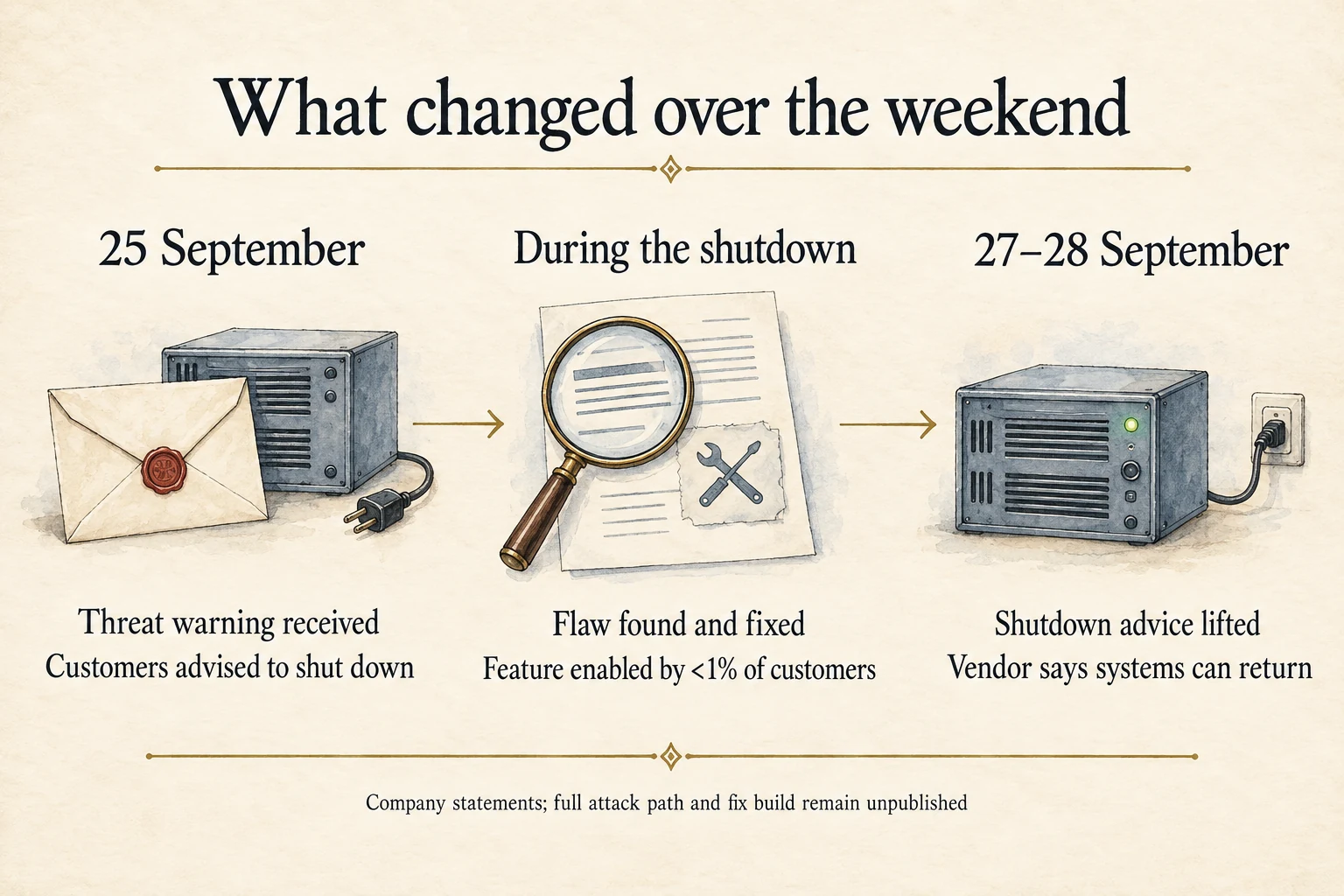
By 28 September, the company said systems could return and described a newly discovered flaw in a feature enabled by fewer than 1% of customers. That raised an uncomfortable question. Why had such a narrowly used feature led to a much broader shutdown request? The sequence in the company's statements matters. It was still investigating when the warning arrived; it found the vulnerability during the shutdown. Applying the later scope to the earlier decision loses the uncertainty that shaped that weekend.
Our assessment is that credible intelligence about an imminent threat can justify a broad, temporary pause. The next responsibility is to turn that warning into instructions customers can use: who is affected, who has been repaired and who needs separate attention. Kiteworks has published its restoration conclusion. The specific repair build and implementation of its protective measures remain unexplained in the statements reviewed here. Those gaps determine what customers still need to ask support.
1 Customers had to carry out the pause
Kiteworks handles secure file and data exchange. Systems of this kind deliberately concentrate sensitive material at controlled transfer points, where organizations can manage access, auditing and delivery. Its forms product documentation describes collected data feeding file sharing, email, MFT, SFTP and API workflows. Taking an entry point down can leave people and applications further along waiting for information, with the actual interruption depending on the deployment and its business connections.
The public advisory dated 25 September specified nine hours for Kiteworks systems, explicitly excluding subsidiary brands including ownCloud, DRACOON and Zivver. Customers managing their own on-premises, AWS or Azure instances had to shut them down; Kiteworks would handle vendor-hosted environments. Customers operating their own machines also need to confirm the work completed on each one.
Readers who remember a six-hour window have a real source for that number. BleepingComputer's contemporary report and the SANS summary recorded an early six-hour notice; the contemporaneous public announcement used nine. These are different durations in different communications. Time-zone conversion does not account for the discrepancy. The public record does not explain the three-hour difference.
Early reporting also said the recommendation extended to instances without direct internet exposure. That made narrower workarounds difficult to assess. Whether blocking a public port would be enough depends on the entry route and component involved, and the notice did not describe that route. Network placement alone gave an administrator little basis for confidently replacing the shutdown advice with a firewall rule.
The unusual notice quickly drew attention. In The Record's original reporting, watchTowr's Jake Knott described a request to shut down an entire customer base without a public CVE, patch or technical details as highly unusual; he also cautioned that a vendor would not ask for this on speculation alone. In the same report, Kiteworks CISO Frank Balonis explained the credible federal intelligence warning and precautionary nature of the advice. The available information explained the vendor's urgency; customers still needed more detail to independently assess their own deployments.
2 The warning came before the vulnerability discovery
Any assessment of that decision has to put the findings back in their original sequence. Kiteworks' 28 September restoration statement says it discovered a previously unknown critical vulnerability during the shutdown, repaired it and added protection across environments. The affected capability was enabled by fewer than 1% of customers, according to the company, which reported no indication of compromise.
The initial pause therefore rested on threat intelligence. The subsequent investigation let the company describe a narrower vulnerability scope. The statements do not establish that Kiteworks already knew exactly which instances needed to stop when it sent the warning. Nor does the later scope settle whether the broader request was necessary at the time. That would require the intelligence itself, the available isolation options and each deployment's exposure. Those details have not been published.
Which feature was involved? A 27 September notice added to the original advisory specifically directed self-hosted Advanced Forms customers to support. SecurityWeek's follow-up also identified Advanced Forms, drawing its additional detail from a customer email reproduced online. The official support instruction gives self-hosted customers somewhere to continue checking their repair status.
The percentage also needs its denominator. It counts customers with the capability enabled. It cannot be used as an intrusion success rate or an estimate of records exposed. Feature enablement, whether a flaw is reachable in a particular deployment, and whether someone actually accessed data are separate questions. The announcements answer part of that picture; local configuration and records are still needed to assess an individual instance.
The company's negative finding is useful as a current observation. The statements do not publish monitoring coverage, payloads, customer logs or a complete investigation method, so they cannot support an independent forensic conclusion for every customer. SOSEC has neither accessed the systems nor reproduced the vulnerability. This investigation follows the publicly documented decisions and repair process, and the choices those statements leave customers able to make.
3 What had to change while the systems were off
A powered-down server stops processing new application requests. That makes shutdown a coarse but direct temporary measure when an entry route or trigger is still uncertain. The cost is equally direct: legitimate users lose access too. Customers accept a definite interruption in exchange for protection against a threat they cannot yet fully assess.
The dispute concerns whether that exchange is worthwhile. In SANS commentary on 25 September, Ed Skoudis supported acting on credible intelligence and emphasized the ability to stop services deliberately. Lee Neely observed that an adversary could change the timing of an attack. These concerns address different parts of the decision. One asks whether to accept disruption promptly; the other asks what will have changed before service returns.
Waiting for a scheduled window to expire leaves a software defect intact. An attacker trying the next day could encounter the same program. A useful pause must produce information that changes the next decision, or allow repair and isolation to be completed. The fix and additional protection described in Kiteworks' later announcement are therefore central to assessing what the shutdown accomplished.
An absence of observed abnormal activity cannot, by itself, measure the contribution of switching off. The pause might have blocked requests. An adversary might not have acted as anticipated. Monitoring limitations not discussed in the announcement might also matter. The public record contains no observations that separate those explanations. It does establish that the company chose a precaution that interrupted customer work and its own service; it does not identify a specific intrusion that this action prevented.
The next question for a customer is therefore what changed on their own system during the shutdown.
4 What the 9.5.1 version number leaves unanswered
Current decisions should start with the restoration notices. The update added on 27 September lifted the shutdown advice, and the 28 September announcement said all customer systems could return. Circulating an old shutdown screenshot takes customers back to an earlier phase of the response. Self-hosted Advanced Forms users also have an explicit support route for instructions that apply to their deployment.
The easy mistake is to treat the version number as a complete answer. On 25 September, the advisory already described 9.5.1 as the current release addressing the issues then known. The company subsequently said it found a previously unknown vulnerability during the shutdown. Seeing 9.5.1 on a machine therefore does not establish, from these two statements alone, that the later repair has reached it. A particular build, hotfix or other deployment action could carry the change; the public announcements do not map the repair precisely enough to choose among those possibilities.
Teams operating their own instances can give Kiteworks support the installed version, full build information and Advanced Forms enablement state, then request confirmation of the required repair and its verification method. Vendor-hosted customers can likewise ask for confirmation covering their environment.
Once repair status is confirmed, check that the business workflow actually works again. Use your own test accounts and non-sensitive files to exercise the submissions, receipt, permissions and downstream delivery that the deployment uses. Reconcile queued or retried work for missed items and duplicate sends. These tests establish service recovery; they do not independently validate the vulnerability repair. Patch confirmation and workflow checks answer different questions, and either can be overlooked when a team is eager to close the incident.
If support cannot yet confirm an instance's repair state, retain the temporary restrictions agreed for it and make the business arrangements explicit. Restoring an old snapshot with unconfirmed repair status simply to accelerate recovery creates another unresolved decision. Whether the whole service must remain restricted, one component can be paused or a vendor action is still pending depends on that installation's plan. Without a public attack path, we cannot recommend a smaller, equally effective containment scope for all customers.
Customers with suspicious access or data anomalies should also preserve the relevant records and continue their own investigation. A software repair does not explain earlier activity or recall information already sent elsewhere. The vendor's general restoration notice helps schedule service, while a customer's actual anomalies require separate attention.
5 A smaller shutdown next time
The vendor and its customers carried different costs. Kiteworks could issue one recommendation; customers had to turn it into on-call arrangements, business notices, shutdowns and restarts. The restoration statement acknowledged people giving up a weekend at short notice and working through the night. That acknowledgement matters. A useful next return for their effort would be a clearer way to identify which group they belong to when another warning arrives.
The limited feature adoption raises a concrete engineering question: can administrators identify and disable that component separately, with a reliable explanation of the protection that doing so provides? The vendor needs to answer that from the implementation. The record does not establish that disabling forms alone would have been sufficient this time. Clear component inventories, dependencies and emergency procedures could nevertheless create more selective options for a future response.
Customers can prepare something practical now: identify whom an emergency pause must notify, which data will be waiting and which alternative channels are already approved. Work continues to exist when a secure-transfer service stops. Moving it into personal email or an unmanaged shared drive can create a new problem during an action intended to protect it. Teams should be able to find out in advance what can wait and what has a controlled fallback.
What customers ultimately need is ordinary and concrete: to know why their service can run again, where to look if something goes wrong and whether less work can be interrupted next time. Those are useful things to keep after an unexpectedly lost weekend.
6 Sources
- Kiteworks: 25 September shutdown advisory, including the added 27 September restoration notice
- Kiteworks: 28 September restoration and repair statement
- The Record: 25 September interviews with Kiteworks and watchTowr
- SANS NewsBites: volume XXVIII, issue 71, 25 September
- BleepingComputer: early six-hour shutdown notice, 25 September
- SecurityWeek: Advanced Forms follow-up, 28 September
- Kiteworks: Secure Data Forms product and workflow documentation
Research basis
Research basisComparison of the publicly documented warning, shutdown, repair and restoration. No customer-system access, private intelligence or vulnerability reproduction. Sources checked through 2026-09-29 13:33 UTC.
SourceCompany statements, original interviews, SANS and public product documentation
Evidence confidence Medium